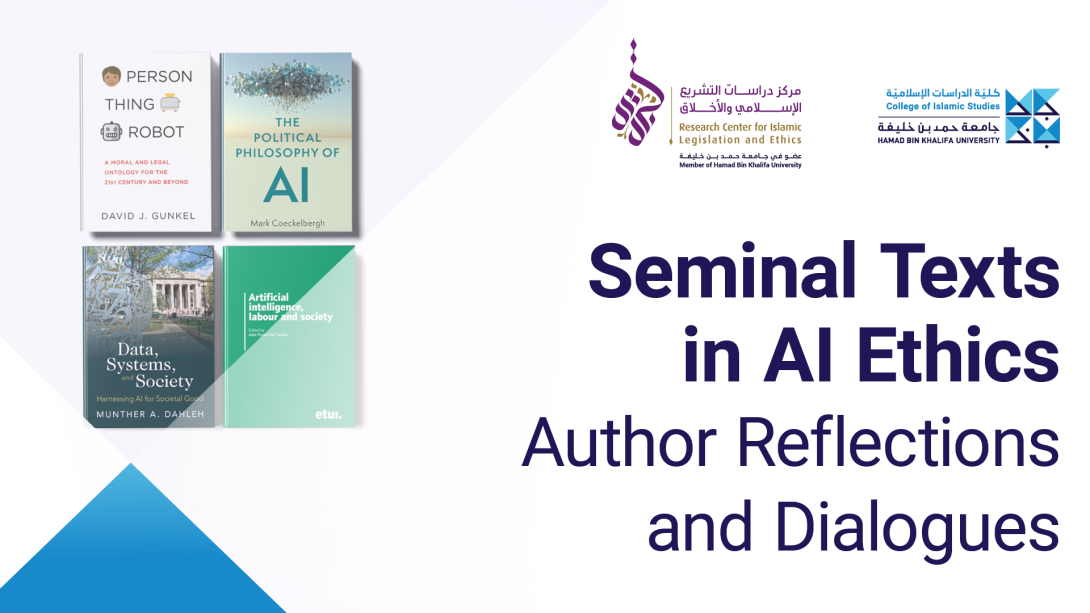
Hosted by the Research Center for Islamic Legislation and Ethics (CILE), the profoundly timely gathering "Seminal Texts in AI Ethics: Author Reflections and Dialogues” offered a multidisciplinary exploration of the ethical dimensions of artificial intelligence. Held as part of the broader HBKU conference "AI Ethics: The Convergence of Technology and Diverse Moral Traditions," this seminar served as a follow-up discussion that deepened and extended the conversations initiated earlier in the event. In his opening remarks, Dr. Mohammed Ghaly, head of CILE, outlined the center’s mission to tackle global ethical challenges like AI through a dual approach that is both deeply rooted in the Islamic scholarly tradition and actively engaged in dialogue with contemporary international thought. Bringing together four distinguished authors, this book event, he explained, was a perfect embodiment of that mission, creating a rich, human-centered space for critical reflection on how AI is reshaping the very fabric of our shared future. With discussants responding to each of the presented books, the seminar fostered a lively and thought-provoking dialogue that brought together insights from diverse fields.
Featured book: ‘Artificial Intelligence, Labour and Society’ by Dr. Aída Ponce Del Castillo, Senior Researcher, European Trade Union Institute in Belgium.
Discussant(s): Dr. Samer Rashwani (CILE)
The first session, led by Dr. Aída Ponce Del Castillo, centered on her book Artificial Intelligence, Labour and Society, grounding the ethical debate in the lived reality of the workplace. She argued that the core issue is not job replacement, but the transformation of work itself, marked by the erosion of human agency, tacit knowledge, and professional autonomy. Dr. Ponce Del Castillo highlighted the “invisible workforce” in the global south—data annotators and content moderators who perform psychologically taxing labor for minimal pay, forming the hidden foundation of AI systems used in the global north. Her call to action was clear: urging for stronger protections such as collective bargaining rights, AI registers, and clear legal boundaries between permissible workplace monitoring and invasive surveillance to protect human dignity at work.
Featured book: ‘Person, Thing, Robot’ by Dr. David Gunkel, Professor of Media Studies Northern Illinois University in USA
Discussant(s): Dr. Abootaleb Safdari (University of Bremen), Dr. Aybike Tunç (Ankara Haci Bayram Veli University)
Dr. David Gunkel, author of ‘Person, Thing, Robot’, then tackled the question of AI’s moral and legal status. Dr. Gunkel challenged the long-standing Western binary that classifies all entities as either “persons” (with rights) or “things” (as property), arguing that AI and robots are “conceptual monsters” that defy this distinction. Rather than forcing these systems into existing categories, he proposed a more fluid, relational approach—one that focuses not on what AI is, but on how we interact with it and how we can responsibly integrate it into our social fabric. Dr. Gunkel emphasized that our ethical and legal systems must evolve to accommodate these new social actors in a way that reflects our lived experiences and protects core human values.
Featured book: ‘The Political Philosophy of AI: An Introduction’ by Dr. Mark Coeckelbergh, Professor of Philosophy of Media and Technology, University of Vienna in Austria
Discussant(s): Dr. Mohammed Ghaly (Head of CILE)
Dr. Mark Coeckelbergh then broadened the discussion to the societal level through his book, The Political Philosophy of AI: An Introduction, where he used the timeless principles of political philosophy—justice, freedom, and democracy—to explore how AI is reshaping the political landscape. He explained that AI, rather than controlling us outright, can quietly erode autonomy through manipulation and “nudging” and how it can hardwire societal biases into systems for credit, justice, and employment, creating new forms of inequality. His most urgent warning concerned democracy itself, where AI-powered misinformation can poison public discourse and create fertile ground for totalitarianism. His solution was a call to arms for a more philosophically informed public debate, one that can articulate why certain AI applications are unjust and how we can steer this technology toward a genuine common good.
Featured book: ‘Data, Systems, and Society: Harnessing AI for Societal Good’ by Dr. Munther Dahleh, William A. Coolidge Professor, Massachusetts Institute of Technology (MIT) in USA
Discussant(s): Dr. Thibaut Horel (Massachusetts Institute of Technology)
Finally, Dr. Munther Dahleh offered a vital perspective from within the heart of technological innovation. Drawing from his book, Data, Systems, and Society: Harnessing AI for Societal Good, and his experience founding MIT’s Institute for Data, Systems, and Society (IDSS), he argued that the key to steering AI toward societal good lies in reimagining education itself. He called for true “transdisciplinarity”; not just collaboration between fields, but the cultivation of a new generation of “trilingual” scholars fluent in data science, their own core discipline (be it anthropology or Islamic studies) and the ethical frameworks that connect them. Dr. Dahleh argued that the most promising path to harnessing AI for societal good is not to retreat from technology, but to empower a diverse and ethically grounded community of leaders capable of consciously and conscientiously designing and governing the systems that shape our future.
In conclusion, the seminar did not seek to offer easy answers but to frame the right questions. It wove a coherent narrative from the micro-level of the individual worker to the macro-level of global political order, unified by a call for human dignity, proactive governance, and interdisciplinary collaboration. The message was clear: the future of AI will not be written in code alone, but through the values, ethical scholarship, and collective wisdom we choose to embed within it, ensuring that technology ultimately serves societal well-being.
The report was edited by Jude N Abdullah.